Improving the Quality of Practice
After studying massage theory and entering active clinical practice, a familiar question inevitably arises: how can one further improve the effectiveness of their work?
The need for professional growth is obvious; the path toward it is far less so.
In theory, everything is simple. There are only two reliable strategies:
- Revisit and refine what has already been learned.
- Study something new.
Both approaches require time, consistency, and patience — qualities that rarely align with the desire for fast and impressive results.
The Rise of “Miracle Courses”
It does not take long before practitioners encounter them: the newest, most advanced, allegedly science-based methods, conveniently reinforced by ancient traditions. These systems promise to treat virtually everything through specialized massage techniques rooted in proprioceptive, neuro-, myo-, fascial-, and several other impressively named mechanisms — often combined into a single, all-encompassing framework.
At this point, it becomes clear that massage history has finally reached a turning point. From now on, there will be “before” and “after.” Massage is about to take its rightful place at the center of medicine.
Upon completing the course, obtaining the certificate, and adding another acronym to one’s name.
The requirements are modest: a bit of time, a reasonable amount of money, and a willingness to believe.
For many, this trajectory begins in college, where students are introduced to similar approaches — briefly and superficially, but enough to ignite enthusiasm and a sense of professional momentum.
The rather limited practical effectiveness of the new method rarely causes concern at first. After all, one is warned in advance: mastery takes time and practice. The real results are yet to come.
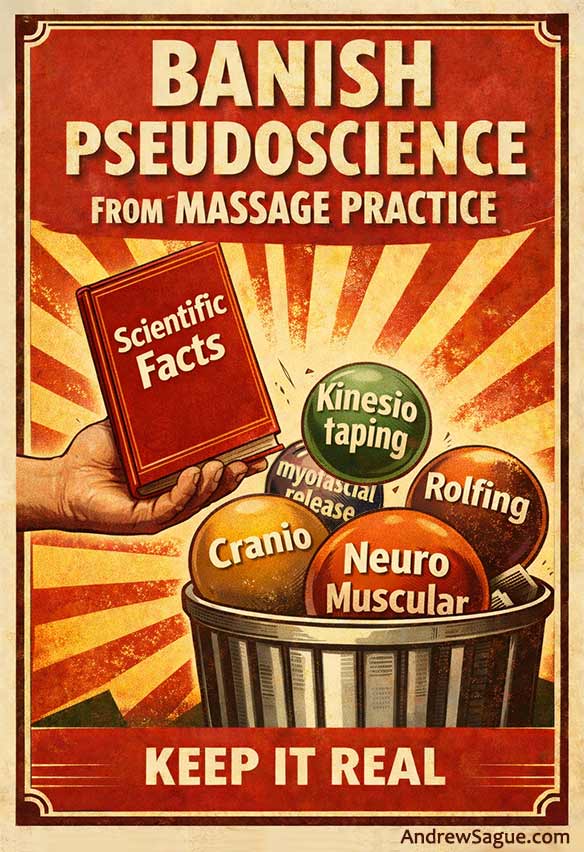
A brief list of pseudoscientific methods
Below is a brief selection of approaches commonly regarded as pseudoscientific. It is, of course, far from exhaustive — there are many more. It is also worth noting that some of these methods, while theoretically unsound, may still contain individual techniques that can be applied pragmatically, provided one does not adopt the accompanying mythology.
- Acupressure
- Aromatherapy — theoretically unjustified, though often pleasant and relaxing.
- Applied Kinesiology
- Craniosacral Therapy
- Gua Sha
- Manual Lymphatic Drainage — with the important exception of clinically confirmed lymphedema.
- Myofascial Release and Rolfing — many techniques can be used, if one ignores the “explanatory framework.”
- Reflexology
- Reiki
- Shiatsu
The central point is simple: maintaining a critical perspective on such “high-impact” systems helps save time, money, and — most importantly — professional effort, allowing it to be invested where evidence and results actually exist.
The Actual Secret of Effectiveness
The secret is surprisingly simple: avoid this path.
Approach any “highly effective,” “revolutionary,” or “unique” method with critical distance. The less time and money spent on such constructs, the higher the actual quality of clinical work tends to be.
Most systems developed and promoted by a single author belong to the domain of pseudoscience. The greater the commercial emphasis and branding effort, the higher the probability that the method itself offers little of substance.
All loudly advertised pseudoscientific approaches share one defining feature: low effectiveness. In practical terms, this means minimal, inconsistent, or entirely absent clinical results.
What to Do Instead
Invest in experience and knowledge. Study theory systematically: anatomy, physiology, biomechanics, and orthopedic assessment. This path does not offer the illusion of rapid breakthroughs, but it builds a solid foundation for clinical reasoning.
Seek out strong practitioners and learn from their experience. Some are willing to share their insights directly. With others, observation works just as well — booking sessions and studying their work firsthand, which is often an unexpectedly effective educational method.
Look for massage courses without new methods and attractive names. You will quickly discover that this is far more difficult than it sounds — such courses are rare. Yet they are precisely the ones that tend to produce meaningful, lasting improvements in practice.