Typical clinical situation
A typical clinical situation presents as follows. An individual experiences emotional tension related to professional activities and spends a significant portion of time in a seated position, often with incorrect posture. Under these conditions, the muscular system is subjected to static overloads, resulting in a state of elevated tone in certain muscle groups.
When negative symptoms begin to dominate, the person starts seeking ways to relieve them, using massage.
Positive subjective sensations usually accompany the relaxation massage procedure itself. However, the overall effect falls short of expectations: pronounced reduction in tension either does not occur or is short-lived, disappearing shortly after the session.
Complex Nature of the Developing Condition
Upon closer examination, it becomes evident that such situations rarely fit within the framework of an isolated problem. As a rule, they develop against the backdrop of a lifestyle that can hardly be described as physiologically favorable.
Symptomatology does not emerge abruptly. It develops gradually over a considerable period and represents the cumulative result of prolonged static positioning, emotional overload, and insufficient recovery. At a certain stage, this state may be compensated and not accompanied by pronounced complaints. Subsequent decompensation creates the illusion of the problem’s “suddenness” precisely at the moment when the individual seeks help.
Challenges in Analyzing and Interpreting the Condition
Analysis of such conditions is complicated by the fact that manifestations associated with prolonged sitting and emotional tension are closely intertwined. Muscular, autonomic, and behavioral components form a complex syndrome in which attempts to rigidly separate causes and effects prove methodologically problematic, require particular attention, and should not be overlooked.
Such analysis—regarded as an indispensable stage in the standard protocol of a professional massage clinic—requires considerable time, ongoing observation, and active involvement from the client. Unfortunately, it is exactly here that the primary barrier most commonly appears.
Client Reluctance to Engage in the Process
In practice, the key issue is the pronounced reluctance of the massage client to engage in analyzing their own condition. Expectations of rapid results are combined with a lack of readiness for cooperation: discussing lifestyle, working conditions, behavioral habits, and specialist recommendations.
This results in a paradoxical situation: there is a request for change in the condition, but participation in the process necessary to achieve that change is effectively absent. This contradiction, in many cases, becomes the determining factor in the reduced effectiveness of the intervention.
Distorted Perception of the Problem-Solving Mechanism
The client’s understanding of their condition and the pathways to its correction is typically oversimplified and often entirely inaccurate. The problem is acknowledged but viewed as something external to daily life. In this framework, massage therapy is perceived as an independent solution that does not require revision of the conditions under which the condition originally developed.
Even in more aware variants, this model is merely supplemented by episodic physical activity or walks, without addressing fundamental factors related to work regimen, stress levels, and workplace organization.
Outcome Evaluation and Shifting of Responsibility
In the absence of the expected effect, responsibility is typically shifted onto the procedure or the massage therapist. Initial expectations and the underlying problem-solving model remain unquestioned.
Thus, the cause of reduced effectiveness is interpreted not as a consequence of the complex condition but as a result of “incorrect actions” by the massage therapist.
This underscores the importance of working with the client in an educational capacity. Forming more accurate representations in the client regarding the nature of the problem and the possibilities for its correction does not resolve the issue itself but significantly reduces the risk of erroneous expectations and redistributes responsibility toward conscious participation.
In such situations, it is inappropriate to begin with relaxation per se or attempts at localized intervention. The primary stage should involve assessing how the client themselves interprets the causes of their condition and the boundaries of possible changes.
Even without in-depth diagnostic knowledge, the massage therapist can identify characteristic expectation patterns at an early stage and shift the focus from the procedure to fostering a more realistic understanding of the recovery process.
Role of Relaxation Massage in the Overall Structure of Recovery
Relaxation massage is not the central element in such situations, though it remains an important component. It cannot compensate for chronic stress, irrational workplace organization, or the absence of adequate recovery between periods of loading.
Clinical practice demonstrates that many massage therapists erroneously place massage at the center of resolving virtually any problem. Another common error is excessive attention to specific and unproven approaches such as myofascial release, reflexology, posture correction, and similar modalities—at the expense of a comprehensive consideration of the condition.
Conclusion
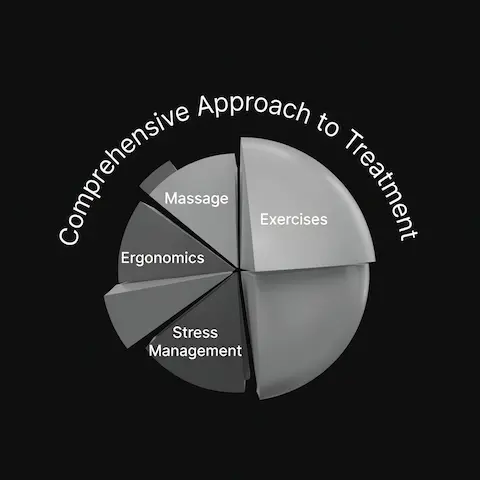
The mere addition of massage, like the mechanical addition of physical activity, rarely leads to sustained changes. The key lies not in expanding the set of procedures but in identifying and correcting existing factors, particularly:
- reducing sources of stress;
- developing skills for managing stress;
- reviewing working conditions and properly organizing the workspace;
- incorporating basic exercises directly into the work process;
- normalizing the regimen of loading and recovery.
Without this, relaxation massage remains an isolated episode capable of providing temporary relief but exerting no substantial influence on the sustainable improvement of the overall condition.